
California’s retirement appeal remains strong despite demographic shifts and slow population growth statewide, with the state holding roughly 39.3–39.5 million residents in recent estimates.
Yet retirees increasingly gravitate toward small towns rather than large metros. Smaller communities offer quieter living, lower congestion, stronger social cohesion, and easier access to nature, all factors widely cited in retirement-livability research.
This article identifies seven genuinely small California towns based on verified population data and examines why they function well for retirement. Each selection considers critical retiree priorities: healthcare proximity, climate stability, housing dynamics, safety perception, and demographic suitability, ensuring the analysis goes beyond generic lifestyle praise.
1. Carmel-by-the-Sea (Monterey County)

With an estimated population of about 3,081 residents, Carmel-by-the-Sea clearly qualifies as a small town. Its demographic profile strongly favors retirees: the median age is around 68.5 years, and roughly 58 % of residents are over 65, reflecting a mature population structure rarely found elsewhere in California. Retirement suitability stems from several measurable factors. Proximity to major healthcare systems in Monterey provides medical access without urban density. The town’s compact 1-square-mile layout supports walkability and short daily travel times. High household incomes and low poverty rates indicate economic stability, while coastal climate patterns help moderate extreme heat. The artistic heritage and limited traffic infrastructure reinforce a slower-paced environment aligned with lifestyle-focused retirement preferences.
2. Pacific Grove (Monterey County)

Pacific Grove’s population sits at roughly 14,700–15,000 residents, positioning it firmly within small-town thresholds despite regional tourism activity. The town offers measurable retirement strengths: established civic infrastructure, coastal environmental protections, and proximity to medical facilities in Monterey. Its tourism-driven economy supports local services without the congestion typical of larger coastal cities.
Pacific Grove’s ocean-moderated climate reduces heat risk, while amenities like marine sanctuaries and historic districts promote active-aging lifestyles. The presence of established public institutions and transportation links ensures accessibility to daily necessities. Crucially, population stability and modest growth rates help preserve community cohesion, an important factor in long-term retirement satisfaction.
3. Pismo Beach (San Luis Obispo County)

Pismo Beach remains a small coastal city with about 8,072 residents at the most recent census, illustrating limited scale compared with regional urban centers. Retirement viability derives from environmental and economic characteristics. The coastal climate offers relatively mild temperatures year-round, which reduces weather-related health risks. Local infrastructure benefits from regional connectivity via Highway 101 while maintaining a lower population density. Healthcare access is supported by nearby facilities in San Luis Obispo, and tourism contributes to service availability without creating sustained metropolitan congestion. Housing costs remain elevated compared with inland towns, yet retirees seeking ocean-adjacent living gain measurable quality-of-life benefits through recreational access and scenic environmental exposure.
4. Avila Beach (San Luis Obispo County)

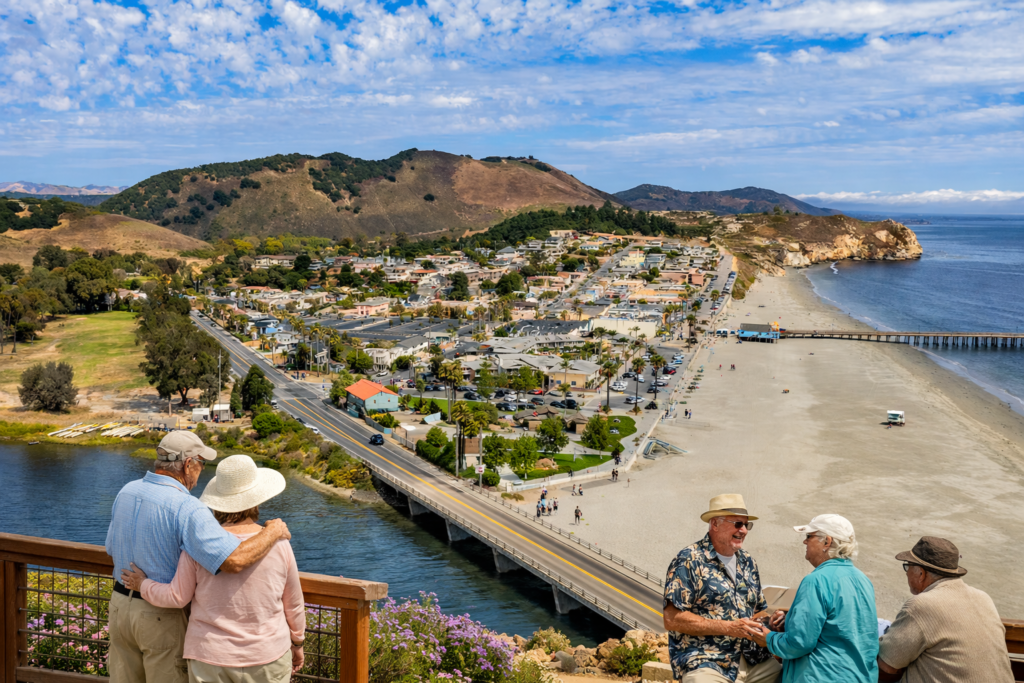
Avila Beach is among the smallest viable retirement communities in California, with about 1,576 residents reported in the latest census data. Demographically, the town skews older: the median age exceeds 60 years, and more than 42 % of residents are 65 or older, demonstrating clear alignment with retirement-age populations. The town’s housing profile also supports retirees: a high owner-occupancy rate indicates residential stability and reduced turnover. Its geographic position offers coastal amenities without the scale of larger tourist hubs. Nearby healthcare and regional transport links help offset isolation risk, while the small population fosters tight-knit community networks that are often associated with improved wellbeing outcomes among older adults.
5. Indian Wells (Riverside County)

Indian Wells has roughly 4,871 residents, placing it well within small-town classification. Located in the Coachella Valley, it benefits from extensive healthcare infrastructure developed to support large seasonal retiree populations. The desert climate, though hot in summer, offers predictable weather patterns valued by many retirees. Economic indicators suggest strong municipal resources, supported by tourism and golf-related development. Infrastructure investments and planned residential communities provide controlled growth and service availability. Compared with larger desert cities, Indian Wells offers quieter residential environments while retaining proximity to regional hospitals, cultural venues, and transportation hubs.
6. Tiburon (Marin County)

Tiburon’s population of roughly 8,800 residents positions it as a small town within commuting reach of the San Francisco Bay Area. This proximity enables access to world-class healthcare while maintaining a residentially scaled environment. The town’s coastal geography supports outdoor recreation and scenic quality-of-life advantages. Housing costs are high, but this correlates with strong municipal services, safety perception, and environmental protections. Transportation connectivity via ferry links reduces reliance on car travel, which can be beneficial for aging residents. Population stability and low growth rates reinforce community continuity, a key factor associated with long-term retirement satisfaction and social integration.
7. Del Monte Forest (Monterey County)

Del Monte Forest is an exceptionally small retirement-focused community with around 3,600 residents, according to recent livability rankings. Its demographic and land-use profile centers on low-density residential planning and environmental conservation. The town benefits from proximity to major healthcare providers on the Monterey Peninsula while maintaining a secluded natural setting.
Retirement suitability stems from predictable climate patterns, high property values indicative of infrastructure investment, and limited commercial expansion. These factors combine to create stable property markets and controlled population growth. The surrounding protected landscapes and coastal ecosystems provide opportunities for low-impact recreation, an important element of active aging strategies.
8. Gold River (Sacramento County)

Gold River, with approximately 7,924 residents, represents a small suburban-style town that balances tranquility with urban accessibility. Its planned development structure supports retiree needs through accessible shopping, healthcare access in Sacramento, and maintained public spaces. Population density remains moderate, preserving residential character while ensuring essential services. Economic stability is supported by proximity to state-government employment hubs and corporate offices, which contributes to local infrastructure funding. Retirees benefit from milder inland climate conditions compared with desert regions and improved cost-of-living relative to coastal enclaves. This combination of scale, accessibility, and municipal planning makes Gold River a pragmatic retirement choice.
Small-town retirement in California is defined less by scenic appeal alone and more by measurable demographic, economic, and infrastructure factors. The towns highlighted here demonstrate verifiable population scale, older resident profiles, and proximity to essential services, particularly healthcare.
While affordability varies widely, retirees prioritizing climate stability, safety perception, and community cohesion may find these locations offer sustainable long-term living environments. California’s overall population trends and migration patterns suggest continued demand for smaller communities, reinforcing the importance of evaluating retirement destinations through data-driven analysis rather than lifestyle marketing narratives.
